
Special Core Drilling Service in Dubai for Precise Concrete Drilling
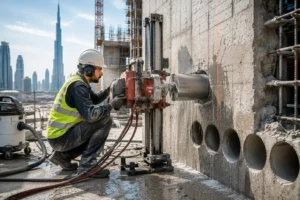
Concrete structures are built for strength, but construction and renovation projects often require accurate openings through walls, floors, slabs, and other solid surfaces. Creating these openings with ordinary tools can lead to uneven results, unnecessary damage, and delays.
A Special Core Drilling Service provides a controlled solution for creating precise circular openings in concrete. Professional diamond core drilling equipment is designed to penetrate hard concrete while maintaining the required hole diameter and drilling direction.
In Dubai, concrete structures can vary significantly in thickness, reinforcement, and material strength. Professional equipment and experienced operators are therefore important when accurate drilling is required.
Special Core Cutting provides core drilling and concrete cutting services in Dubai and across the UAE. Its service range includes core drilling, wall sawing, floor saw cutting, AC duct cutting, lift cutting, beam cutting, concrete scanning, and other specialized concrete work.
What Is Core Drilling?
Core drilling is a specialized method used to create circular holes through concrete and other suitable construction materials.
The process uses a cylindrical diamond core bit that rotates against the concrete surface. As the bit penetrates the material, it removes a cylindrical section and leaves a clean circular opening.
The required hole diameter depends on the installation.
For example, a small opening may be required for an electrical conduit, while a larger opening may be needed for a drainage pipe or HVAC service.
Unlike uncontrolled breaking, core drilling focuses on removing only the required section of material.
What Makes a Special Core Drilling Service Different?
Professional core drilling is more than simply making a hole in concrete.
The contractor must consider the structure, hole size, drilling depth, reinforcement, access, equipment, and surrounding services before starting.
A reliable service should provide:
- Accurate measurements
- Suitable diamond core bits
- Professional drilling equipment
- Experienced operators
- Proper equipment positioning
- Controlled drilling
- Water management where required
- Concrete core removal
- Site cleanup
These factors help produce consistent results and reduce unnecessary problems during the installation stage.
Main Applications of Core Drilling
A Special Core Drilling Service can be useful across residential, commercial, and industrial projects.
Plumbing Installations
Plumbing systems often require pipes to pass through concrete walls and floors.
Core drilling can create circular openings for:
- Water pipes
- Drainage pipes
- Waste pipes
- Plumbing sleeves
- Service connections
The opening should be positioned according to the plumbing layout so that the pipe can be installed without unnecessary modification.
HVAC Systems
Air conditioning and mechanical systems are essential in Dubai buildings.
Core drilling can create suitable circular penetrations for HVAC pipes, refrigerant lines, condensate routes, and other services.
The required hole size should be confirmed with the HVAC installation team before drilling.
Electrical Installations
Electrical systems may require conduits and cables to pass through existing concrete structures.
Core drilling can provide controlled openings for suitable electrical routes.
Before drilling an existing wall or slab, concealed electrical services should be considered.
Drainage Work
Drainage installations frequently require openings through floors and concrete slabs.
A correctly positioned core hole can allow the required pipe to pass through the structure while keeping the surrounding concrete relatively undisturbed.
Ventilation
Commercial and industrial properties may require openings for ventilation systems.
Core drilling can be suitable for smaller circular penetrations, while larger rectangular ventilation openings may require wall cutting or another specialized method.
Core Drilling for Residential Projects
Residential properties may require concrete drilling during construction, renovation, or maintenance.
Common applications include:
- Bathroom plumbing
- Kitchen drainage
- AC installations
- Electrical routes
- Water systems
- Ventilation
- Renovation work
For example, a villa renovation may require a new pipe to pass through an existing concrete floor.
Instead of breaking a large section of the floor, controlled core drilling can create an opening at the required location.
This approach can help the following installation work proceed more efficiently.
Core Drilling for Commercial Buildings

Commercial buildings often contain complex mechanical and electrical systems.
When an office, hotel, restaurant, retail unit, or commercial facility is renovated, new services may need to pass through existing concrete structures.
Core drilling can be used for suitable penetrations related to:
- Plumbing
- HVAC
- Electrical systems
- Drainage
- Mechanical services
- Fire protection systems
Commercial projects also require careful coordination because multiple contractors may be working in the same area.
The drilling location should therefore be confirmed before equipment is installed.
Core Drilling for Industrial Projects
Industrial facilities may contain thick and heavily reinforced concrete.
Factories, warehouses, workshops, and production facilities may require openings for machinery, piping, drainage, ventilation, and electrical systems.
The contractor should assess the concrete thickness and reinforcement before selecting the drilling equipment.
Deep or large diameter drilling may require specialized equipment and additional planning.
Diamond Core Drilling Equipment
The quality of a drilled opening depends heavily on the equipment being used.
Professional core drilling systems typically include:
Core Drilling Machine
The drilling machine provides the rotational power required to operate the diamond core bit.
Diamond Core Bit
The core bit performs the actual cutting.
Different bit sizes and specifications are available for different concrete conditions and hole diameters.
Rig or Mounting System
A stable mounting system helps keep the drill aligned during operation.
This is particularly important for deep drilling and larger diameter openings.
Water Cooling System
Wet drilling commonly uses water to cool the diamond segments and control concrete dust.
The water flow must be managed carefully to prevent uncontrolled slurry.
Why Diamond Core Drilling Is Effective
Diamond is extremely hard and is well suited to cutting dense construction materials.
Diamond core bits can penetrate:
- Plain concrete
- Reinforced concrete
- Masonry
- Concrete blocks
- Other suitable hard materials
The correct diamond bit should be selected according to the material and drilling requirements.
Using the wrong bit can reduce drilling efficiency and increase equipment wear.
Concrete Scanning Before Drilling
Existing concrete structures may contain hidden components.
These can include:
- Steel reinforcement
- Electrical cables
- Water pipes
- Communication lines
- Post tensioning elements
- Other embedded services
These components may not be visible from the outside.
Concrete scanning can help identify hidden elements before drilling.
This can be particularly important in existing commercial buildings and reinforced concrete structures.
Special Core Cutting also lists 3D concrete scanning among its services for identifying and interpreting what is beneath concrete surfaces.
Wet Core Drilling
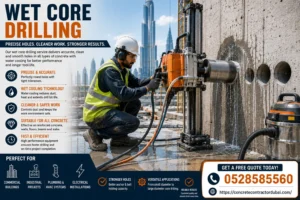
Wet drilling is commonly used for professional concrete coring.
Water is directed toward the drilling area during operation.
It can help:
- Cool the diamond bit
- Control heat
- Reduce airborne dust
- Flush concrete particles from the hole
However, wet drilling produces slurry.
The work area should therefore be protected before drilling begins.
Proper slurry collection and cleanup are important, especially inside finished buildings.
Dry Core Drilling
Some locations may not allow water to be used.
In such situations, dry drilling may be considered if the equipment and application are appropriate.
Dry drilling can produce more dust, so suitable dust control measures should be considered.
The contractor should decide between wet and dry drilling based on the concrete, hole size, depth, location, and site conditions.
Factors That Affect Core Drilling
Several factors can influence the drilling process.
Concrete Strength
High strength concrete can require specialized diamond equipment.
Hole Diameter
Larger holes generally require larger core drilling systems.
Drilling Depth
Deep holes require suitable equipment and core bits capable of reaching the required depth.
Reinforcement
Steel reinforcement can affect drilling speed and diamond bit wear.
Access
Restricted areas can make equipment positioning more difficult.
Operator Experience
Experienced technicians can adjust the drilling process according to changing concrete conditions.
Importance of Accurate Measurements
The drilling location should be measured carefully before equipment is installed.
An incorrectly positioned hole can create problems for the next stage of construction.
The contractor should confirm:
- Hole diameter
- Hole location
- Required depth
- Drilling direction
- Concrete thickness
- Installation requirements
For projects involving multiple holes, each location should be marked according to the approved layout.
Professional Core Drilling Process
A professional core drilling project should follow a planned process rather than beginning with drilling immediately.
Site Assessment
The first step is to inspect the drilling location.
The technician checks the concrete surface, accessibility, thickness, required hole size, and surrounding conditions.
If the structure is already occupied, additional precautions may be required to protect nearby equipment, furniture, flooring, and finished surfaces.
Marking the Drilling Point
After the assessment, the exact drilling location is marked.
The center point should match the approved construction drawings or installation requirements.
Accurate marking is particularly important when several holes are required.
Checking Concealed Elements
Before drilling, the area should be checked for possible reinforcement, cables, pipes, or other embedded components.
Where necessary, concrete scanning can be performed.
This step can help reduce the risk of damaging concealed building services.
Equipment Setup
The drilling machine is positioned at the marked location.
For professional drilling, the equipment should remain stable throughout the operation.
The core bit is selected according to the required diameter and concrete condition.
Controlled Drilling
The diamond core bit gradually penetrates the concrete.
The operator controls drilling pressure and monitors the machine during the process.
For wet drilling, water is supplied to the cutting area to help control heat and dust.
Core Removal
After reaching the required depth, the cylindrical concrete core is removed.
For larger or deeper holes, additional handling may be required.
The opening is then checked to confirm that it meets the required dimensions.
Core Drilling in Reinforced Concrete

Reinforced concrete contains steel bars that increase structural strength.
Because the reinforcement is embedded inside the concrete, it may not be visible from the surface.
Diamond core drilling can be used on reinforced concrete when the correct equipment and drilling technique are selected.
However, reinforcement should not simply be cut without considering the structural design.
For structural elements, the proposed drilling location should be reviewed according to the project’s engineering requirements.
This is particularly important for:
- Beams
- Columns
- Structural slabs
- Load bearing walls
- Foundations
- Post tensioned structures
The drilling contractor should follow the approved project instructions.
Core Drilling in Concrete Slabs
Concrete slabs are frequently drilled during building services installation.
Typical applications include:
- Plumbing
- Drainage
- Electrical conduits
- HVAC services
- Mechanical systems
- Service penetrations
The drilling location should be coordinated with the installation team.
For example, if a drainage pipe needs to pass through a slab, the hole must be positioned according to the pipe route and required dimensions.
Where structural reinforcement or post tensioning may be present, appropriate checks should be completed before drilling.
Core Drilling Through Concrete Walls
Concrete walls can require circular openings for different services.
A professional Special Core Drilling Service can be used for suitable wall penetrations where a circular opening is required.
Common examples include:
- AC pipe routes
- Plumbing
- Electrical conduits
- Ventilation
- Drainage
- Mechanical services
The wall thickness and required drilling depth should be confirmed before selecting the equipment.
Core Drilling for HVAC Pipe Routes
Dubai’s climate makes air conditioning an essential part of most buildings.
During HVAC installation or replacement, technicians may need to pass refrigerant lines, condensate pipes, or other services through concrete walls.
Core drilling can create a controlled circular penetration for these installations.
The drilling diameter should provide enough space for the planned pipe or sleeve without creating an unnecessarily large opening.
Proper positioning also helps reduce installation complications.
Core Drilling for Plumbing and Drainage
Plumbing and drainage systems often require openings through floors and walls.
A core hole can provide a controlled route for pipes.
Before drilling, the plumbing contractor should confirm the pipe dimensions and final route.
The drilling team can then create the opening at the required position.
For drainage applications, the opening location may also need to accommodate the required pipe direction and installation angle.
Core Drilling for Electrical Services

Electrical upgrades in existing buildings can require new service penetrations.
Core drilling can be useful when a circular opening is required for conduits or suitable cable routes.
Before drilling, existing electrical installations should be considered.
This is especially important in older buildings where updated drawings may not be available.
Core Drilling for Mechanical Installations
Mechanical equipment may require service connections through concrete structures.
These can include:
- Pipes
- Supports
- Utility lines
- Ventilation systems
- Equipment connections
The required opening should be based on the mechanical installation specifications.
Accurate drilling can make it easier for the installation team to position the required components.
Advantages of Professional Core Drilling
High Accuracy
Professional drilling equipment can create holes according to specified dimensions.
Controlled Cutting
The drilling process removes a cylindrical section rather than breaking a large surrounding area.
Clean Circular Openings
Diamond core drilling is designed specifically for circular penetrations.
Reduced Surface Damage
Controlled drilling can help limit unnecessary damage around the required opening.
Suitable for Renovation
Existing buildings can be modified without using large scale uncontrolled demolition for every service penetration.
Multiple Applications
The same basic drilling technique can support plumbing, HVAC, electrical, drainage, and mechanical projects.
Core Drilling Versus Conventional Drilling
Conventional drilling tools may be suitable for smaller holes in less demanding materials.
Concrete core drilling is different because it uses a cylindrical diamond bit designed for larger and deeper openings through hard materials.
| Feature | Core Drilling | Conventional Drilling |
|---|---|---|
| Hole Shape | Circular | Circular |
| Large Diameters | Suitable | Limited |
| Reinforced Concrete | Suitable with correct equipment | Often unsuitable |
| Deep Concrete | Suitable | Limited |
| Precision | High | Depends on equipment |
| Main Applications | Construction services | Smaller fixing work |
For structural concrete and larger service penetrations, professional core drilling is generally more appropriate.
Core Drilling Versus Wall Saw Cutting
The shape of the required opening is an important factor when choosing a cutting method.
Core drilling is designed to create circular holes.
Wall sawing is better suited to straight cuts and larger rectangular openings.
Core drilling can be used for:
- Pipes
- Cables
- Drainage
- Circular service penetrations
Wall sawing can be used for:
- Doors
- Windows
- Large ducts
- Rectangular openings
Selecting the correct technique helps avoid unnecessary cutting and additional work.
How to Select a Professional Core Drilling Contractor

Choosing a contractor should involve more than comparing prices.
Consider the following factors before booking a service.
Equipment Quality
The contractor should have suitable professional drilling equipment and diamond core bits.
Technical Experience
Operators should understand different concrete conditions and drilling requirements.
Safety Practices
The company should follow appropriate safety procedures and control the work area during drilling.
Project Assessment
A professional contractor should understand the project requirements before starting.
Concrete Scanning Capability
For suitable projects, access to scanning or detection services can be useful.
Site Cleanup
Concrete slurry and drilling debris should be managed properly after the work.
Questions to Ask Before Booking Core Drilling
Before hiring a drilling contractor, ask clear questions about the project.
What Hole Diameter Can You Drill?
The contractor should confirm whether the required diameter can be achieved with available equipment.
Can You Drill Reinforced Concrete?
Ask whether the company has suitable equipment for reinforced concrete.
Do You Provide Concrete Scanning?
If concealed services may be present, ask whether scanning is available.
Do You Use Wet Drilling?
Confirm whether wet drilling is suitable for your location.
How Will Slurry Be Managed?
This is especially important for indoor projects.
How Will the Concrete Core Be Removed?
Large cores may require additional handling.
Can You Work in Occupied Buildings?
If the building is operational, discuss working hours, noise, dust, water, and access requirements.
Safety Considerations
Core drilling involves powerful equipment and heavy concrete components.
The work area should therefore be prepared before drilling.
Important considerations include:
- Secure equipment installation
- Proper operator training
- Protective equipment
- Electrical safety
- Water management
- Safe concrete removal
- Controlled access
- Appropriate debris handling
The drilling area should remain clear of people who are not involved in the operation.
Managing Concrete Slurry
Wet core drilling creates a mixture of water and concrete particles.
If it is not controlled, slurry can spread across floors and nearby surfaces.
Professional site preparation may include:
- Protective sheets
- Water barriers
- Collection trays
- Wet vacuum systems
- Drain protection
- Slurry removal
The area should be cleaned after drilling so that other trades can continue their work safely.
Core Drilling in Finished Buildings
Drilling inside an occupied or finished property requires additional planning.
The contractor may need to protect:
- Flooring
- Walls
- Furniture
- Electrical equipment
- Finished surfaces
- Nearby installations
Noise and water should also be considered.
For commercial buildings, drilling may be scheduled during approved working hours to minimize disruption.
Why Choose Special Core Cutting?

Special Core Cutting provides specialized concrete cutting and drilling services for construction, renovation, and building service requirements.
The company lists core drilling among its main services and also provides wall sawing, floor sawing, concrete scanning, AC duct cutting, beam cutting, lift cutting, and other specialized concrete cutting solutions. (specialcorecutting.com)
Its service range allows different cutting methods to be considered according to the structure and opening requirements.
For example, a project may require circular core holes for plumbing while also needing wall sawing for a larger opening.
Having access to multiple concrete cutting techniques can simplify coordination for contractors and property owners.
When Should You Use Core Drilling?
Core drilling is a practical choice when the project requires a circular opening through concrete.
It is especially useful when:
- A pipe needs to pass through a wall
- A drainage route needs to pass through a slab
- HVAC lines require a wall penetration
- Electrical conduits need a controlled opening
- Mechanical services require circular penetrations
- Renovation work requires new service routes
If the required opening is rectangular or very large, another cutting method may be more appropriate.
What Affects Core Drilling Cost?
The price of concrete drilling depends on the specific project.
Important factors can include:
- Number of holes
- Hole diameter
- Drilling depth
- Concrete thickness
- Concrete strength
- Reinforcement
- Site accessibility
- Working conditions
- Equipment requirements
- Water and slurry management
A professional contractor should evaluate the project before providing a final quotation.
Comparing quotations only by price may not provide a complete picture.
Equipment quality, operator experience, safety procedures, and project requirements should also be considered.
Frequently Asked Questions
What is a Special Core Drilling Service?
A Special Core Drilling Service uses professional diamond drilling equipment to create accurate circular openings through concrete and other suitable construction materials.
What is core drilling mainly used for?
Core drilling is commonly used for plumbing, HVAC, electrical conduits, drainage, ventilation, mechanical services, and other circular concrete penetrations.
Can core drilling cut reinforced concrete?
Yes. Suitable diamond core drilling equipment can be used for reinforced concrete, although reinforcement and structural requirements should be considered before drilling.
Is concrete scanning necessary before drilling?
Scanning can be useful when concealed reinforcement, cables, pipes, or other embedded components may be present.
Does core drilling create dust?
Wet core drilling can help reduce airborne dust, while dry drilling can produce more dust. The appropriate method depends on site conditions.
Does core drilling use water?
Many professional drilling applications use water to cool the diamond bit and control dust. Indoor projects require proper slurry management.
Can core drilling be used on concrete slabs?
Yes. Core drilling is commonly used on suitable concrete slabs for plumbing, drainage, electrical, HVAC, and mechanical service penetrations.
Can core drilling be performed inside buildings?
Yes. Core drilling can be performed inside residential and commercial buildings when suitable equipment, protection, water control, and safety measures are used.
How long does core drilling take?
The time depends on hole diameter, drilling depth, concrete strength, reinforcement, access, and the number of holes required.
How should I choose a core drilling contractor?
Look for suitable equipment, experienced operators, safety procedures, project assessment, scanning capability where required, and proper cleanup practices.
Conclusion
A professional Special Core Drilling Service provides an accurate method for creating circular openings through concrete structures.
From plumbing and drainage to HVAC, electrical, ventilation, and mechanical installations, core drilling can support many construction and renovation requirements.
The most important step is to match the drilling method with the structure and installation requirement.
Special Core Cutting provides specialized concrete cutting and drilling solutions in Dubai and the UAE, with services covering core drilling, wall sawing, floor sawing, concrete scanning, and other concrete cutting applications. (specialcorecutting.com)
Get Professional Core Drilling in Dubai

If you need accurate circular openings through concrete for plumbing, HVAC, electrical, drainage, or mechanical installations, professional core drilling can provide a controlled solution.
Before work begins, confirm the hole diameter, drilling depth, exact location, and purpose of the opening.
A proper site assessment can help identify equipment requirements and potential concealed elements.