
Core Cutting Company in Dubai for Precise Concrete Cutting
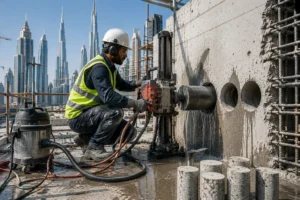
Concrete structures are designed to provide strength and durability, but construction projects often require carefully planned modifications. New plumbing routes, air conditioning systems, electrical services, drainage lines, doors, windows, and mechanical installations may require cutting or drilling through existing concrete.
This is where choosing the right Core Cutting Company in Dubai becomes important.
Professional concrete cutting is not simply about breaking or removing concrete. It requires suitable diamond equipment, accurate measurements, experienced operators, proper site preparation, and an understanding of the structure being modified.
Special Core Cutting provides concrete cutting and drilling services in Dubai and other UAE locations. Its service range includes core drilling, wall sawing, floor saw cutting, AC duct cutting, lift cutting, window cutting, beam cutting, concrete scanning, and demolition.
This guide explains what professional core cutting involves, where it is used, how the process works, and what to consider when selecting a concrete cutting specialist.
What Is Concrete Core Cutting?
Concrete core cutting is a specialized drilling method used to create circular openings through concrete structures.
Instead of breaking a large area, a cylindrical diamond core bit rotates through the concrete and removes a specific circular section.
The resulting opening can be used for different building services.
Typical applications include:
- Plumbing pipes
- Drainage systems
- Electrical conduits
- HVAC lines
- Ventilation
- Mechanical services
- Cable routes
- Utility penetrations
The required hole diameter depends on the installation.
For example, a small electrical conduit may need only a relatively small penetration, while a drainage or mechanical pipe may require a much larger opening.
Why Professional Core Cutting Matters
Concrete can contain reinforcement, embedded services, and other materials that are not visible from the surface.
Using unsuitable equipment or cutting without proper planning can result in damaged concrete, incorrect openings, broken services, or unnecessary repair work.
Professional core cutting focuses on controlled removal.
Before drilling, the contractor can review the required diameter, depth, position, and surrounding conditions.
This allows the drilling method and equipment to be selected according to the project.
A professional approach can provide several benefits.
Better Accuracy
The drilling location and diameter can be established before the equipment is operated.
Controlled Concrete Removal
Only the required cylindrical section is removed.
Suitable for Hard Concrete
Diamond core drilling equipment is designed for demanding concrete applications.
Cleaner Installation Openings
A properly performed core hole can provide a suitable penetration for pipes, conduits, and other services.
Improved Project Coordination
Accurate openings can make it easier for plumbing, HVAC, electrical, and mechanical contractors to continue their work.
Core Drilling and Diamond Technology
Diamond technology is an important part of professional concrete drilling.
Diamond segments are incorporated into the cutting edge of the core bit.
As the bit rotates, the diamond segments gradually cut through the concrete.
The appropriate core bit depends on several factors.
These include:
- Concrete strength
- Hole diameter
- Drilling depth
- Aggregate type
- Reinforcement
- Site conditions
Using a suitable diamond bit helps the operator achieve more consistent drilling performance.
Main Applications of Core Cutting
A professional Core Cutting Company in Dubai can support many types of construction and renovation projects.
Plumbing Openings
Plumbing systems often require pipes to pass through concrete floors and walls.
Core drilling can create circular penetrations for water lines, drainage pipes, waste pipes, and sleeves.
The opening should be positioned according to the approved plumbing layout.
HVAC Installations
Dubai buildings rely heavily on air conditioning.
HVAC installations can require openings for refrigerant lines, condensate pipes, and other mechanical services.
Core drilling can provide suitable circular penetrations for these routes.
Electrical Services
Electrical upgrades may require conduits or cable routes to pass through existing concrete.
Core drilling can be suitable where a circular penetration is required.
Before drilling, concealed electrical services should be considered, especially in existing buildings.
Drainage Systems
Drainage pipes may need to pass through concrete slabs, floors, or walls.
A correctly positioned core opening can provide a controlled route for the pipe.
The hole size should be selected according to the pipe and sleeve requirements.
Mechanical Services
Industrial and commercial buildings often contain complex mechanical systems.
Core drilling can provide penetrations for suitable pipes, service routes, and equipment connections.
Core Cutting for Residential Projects

Residential properties frequently require modifications during renovation.
A villa or apartment may need new openings for plumbing, drainage, air conditioning, electrical work, or ventilation.
For example, a renovation contractor may need to install a new drainage pipe through an existing concrete floor.
Breaking the surrounding floor with heavy demolition equipment could create unnecessary damage.
A controlled core drilling process can create the required circular opening at the specified location.
Residential projects also require careful consideration of finished surfaces.
Flooring, walls, furniture, electrical equipment, and nearby installations should be protected before work starts.
Core Cutting for Commercial Buildings
Commercial properties often undergo fit out and renovation work.
Offices, retail units, restaurants, hotels, and other facilities may require new service penetrations.
Common requirements include:
- HVAC modifications
- Plumbing upgrades
- Drainage
- Electrical routes
- Mechanical services
- Ventilation
Commercial projects can be more demanding because several contractors may be working at the same time.
Accurate coordination is therefore important.
The cutting team should receive the correct drawings, measurements, and opening locations before starting work.
Core Cutting for Industrial Facilities
Industrial structures can contain thick and heavily reinforced concrete.
Factories, warehouses, workshops, and production facilities may require openings for machinery, pipes, electrical systems, drainage, and ventilation.
The drilling requirements can vary considerably from one project to another.
Before work begins, the contractor should consider concrete thickness, reinforcement, access, hole diameter, drilling depth, and equipment requirements.
Large or deep holes may require specialized drilling systems.
Core Cutting in Reinforced Concrete
Reinforced concrete contains steel bars that improve structural strength.
These bars can affect the drilling process.
A diamond core bit may encounter reinforcement while passing through the concrete.
Professional equipment can be selected according to the expected conditions, but the structural importance of the area must also be considered.
Before drilling beams, columns, structural slabs, or load bearing walls, the proposed opening should be assessed according to the project’s engineering requirements.
Core cutting should not be treated as a simple drilling task when a structural element is involved.
Concrete Scanning Before Core Cutting
One of the most important considerations when modifying existing concrete is what may be hidden beneath the surface.
A concrete wall or slab can contain:
- Steel reinforcement
- Electrical cables
- Water pipes
- Communication lines
- Post tensioning elements
- Other embedded components
These items may not be visible from the outside.
Concrete scanning can help identify concealed elements before cutting begins.
Special Core Cutting provides 3D concrete scanning services for analyzing and interpreting what is beneath concrete surfaces.
Scanning can be particularly valuable during renovation projects where original structural or service drawings are incomplete.
Wet Core Cutting

Wet core drilling uses water during the drilling process.
The water can help cool the diamond cutting segments and control dust.
This can be useful when drilling dense concrete or creating deeper openings.
Wet drilling can help provide more controlled working conditions, but it also creates concrete slurry.
The work area should therefore be prepared before drilling begins.
Suitable measures can include:
- Protective floor coverings
- Water barriers
- Slurry collection
- Wet vacuum equipment
- Drain protection
- Final cleaning
Water management is especially important inside completed buildings.
Dry Core Cutting
Some locations may not allow water to be used.
Dry drilling may be considered when the equipment and application are suitable.
The main concern is dust generation.
Concrete dust should be controlled using appropriate methods and protective equipment.
The decision between wet and dry drilling depends on the concrete, drilling depth, hole diameter, location, and project requirements.
Professional Core Cutting Process
A reliable concrete cutting project should follow a clear process.
Site Assessment
The technician first evaluates the drilling location.
Important factors include concrete type, thickness, access, required hole size, and surrounding conditions.
Location Marking
The exact drilling point is marked according to the approved measurements.
Service Assessment
Potential reinforcement, electrical services, pipes, or other concealed elements should be considered.
Scanning may be appropriate where required.
Equipment Selection
The contractor selects the core drilling machine and diamond bit according to the required diameter and depth.
Equipment Positioning
The drilling system is positioned securely.
Correct alignment helps maintain the intended drilling direction.
Controlled Drilling
The operator gradually advances the diamond core bit through the concrete.
Water may be used depending on the selected drilling method.
Core Removal
After reaching the required depth, the concrete core is removed safely.
The opening is then inspected before the next construction stage begins.
What Makes a Reliable Core Cutting Contractor?
Selecting a concrete cutting contractor should involve more than comparing quotations.
Several factors should be reviewed.
Experience
Practical experience helps technicians deal with different concrete conditions and site challenges.
Suitable Equipment
Professional diamond drilling equipment should match the required hole size and drilling depth.
Skilled Operators
The operator needs to understand equipment setup, drilling pressure, water flow, and concrete conditions.
Safety Procedures
The work area should be controlled and equipment should be operated according to appropriate safety practices.
Site Assessment
A contractor should understand the project requirements before beginning the cutting work.
Range of Services
A company offering multiple cutting techniques can be useful when one project requires different types of concrete modification.
Special Core Cutting lists core drilling alongside wall sawing, floor saw cutting, AC duct cutting, lift cutting, beam cutting, concrete scanning, and demolition services.
Core Cutting Versus Wall Sawing
Core cutting and wall sawing are both diamond cutting techniques, but they serve different purposes.
Core drilling is primarily used for circular openings.
Wall sawing is designed for straight cuts and larger openings.
| Feature | Core Cutting | Wall Sawing |
|---|---|---|
| Opening Shape | Circular | Straight or rectangular |
| Common Application | Pipes and conduits | Doors and windows |
| Small Penetrations | Highly suitable | Usually unnecessary |
| Large Openings | Limited | More suitable |
| HVAC Pipes | Suitable | Usually unnecessary |
| Large Duct Openings | Limited | Suitable |
Selecting the right technique depends on the required shape and dimensions of the opening.
Core Cutting Versus Concrete Breaking
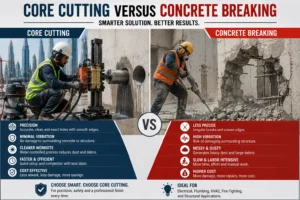
Traditional breaking uses impact to fracture concrete.
Core cutting removes a controlled cylindrical section.
For service penetrations, controlled drilling is generally more appropriate because the required opening can be established precisely.
Concrete breaking may be more suitable when a large section needs to be removed as part of demolition.
The correct method depends on the project’s objective.
Benefits of Professional Core Cutting
Professional core cutting offers several practical advantages for construction and renovation projects.
Precise Circular Openings
Diamond core drilling is designed to create circular openings with controlled dimensions.
This makes it suitable for pipes, conduits, drainage systems, HVAC lines, and other building services.
Controlled Concrete Removal
Instead of breaking a large surrounding area, core drilling removes a defined cylindrical section.
This helps keep the work more controlled and can reduce unnecessary damage.
Suitable for Reinforced Concrete
Professional diamond equipment can be used for reinforced concrete applications when the correct drilling system and core bit are selected.
The presence of reinforcement should still be considered before work begins.
Better Installation Preparation
A correctly positioned core hole gives the next contractor a defined route for installing pipes, cables, or mechanical services.
Useful for Renovation Work
Core drilling can be particularly useful when existing buildings need new service penetrations without large scale demolition.
How to Choose a Core Cutting Company in Dubai
Choosing a contractor should be based on technical capability rather than price alone.
Several factors deserve attention before booking a service.
Experience With Different Concrete Structures
Concrete conditions vary between residential buildings, commercial properties, and industrial facilities.
An experienced contractor should understand how equipment and cutting methods need to change according to the structure.
Professional Equipment
The company should have suitable core drilling machines and diamond bits for the required hole diameter and depth.
Trained Operators
Experienced operators understand equipment positioning, drilling pressure, water management, and concrete conditions.
Safety Practices
The contractor should establish a controlled work area and use suitable protective equipment during drilling.
Site Inspection
A proper assessment before work begins can help identify access limitations, concrete thickness, reinforcement, and other important conditions.
Core Cutting for Construction Projects
Core drilling is frequently used during new construction.
Building service contractors may need openings for plumbing, electrical systems, HVAC installations, drainage, and other utilities.
During construction, accurate coordination is important because the location of each opening should match the approved service layout.
For example, if several plumbing pipes need to pass through a concrete slab, each hole should be marked according to the final installation plan.
This reduces the chance of unnecessary additional drilling.
Core Cutting for Renovation Projects
Renovation work can be more complicated because the concrete structure already exists.
The original drawings may be incomplete, and building services may have been modified over time.
Before drilling, the contractor should understand the existing conditions.
Concrete scanning may be useful when hidden reinforcement, pipes, cables, or other embedded elements are suspected.
A controlled drilling process can then create the required opening while limiting unnecessary disturbance to the surrounding area.
Core Cutting for HVAC Installation
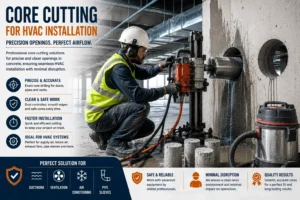
Dubai properties depend heavily on air conditioning systems.
When an HVAC system is installed or upgraded, service lines may need to pass through concrete walls or floors.
Core drilling can create suitable circular penetrations for:
- Refrigerant lines
- Condensate pipes
- Small mechanical services
- Service sleeves
- HVAC connections
The hole diameter should be confirmed before drilling.
The location should also match the HVAC layout so that the installation team can complete the work without unnecessary adjustments.
Core Cutting for Drainage Systems
Drainage work often requires openings through concrete slabs and floors.
The opening must be positioned according to the drainage route and pipe dimensions.
A professional drilling contractor can create a controlled circular penetration for the required pipe.
Where the slab is structural, the proposed drilling location should be assessed before cutting.
Core Cutting for Electrical Services
Electrical upgrades can require new conduits and service routes.
Core drilling can be useful where a circular penetration is required through concrete.
Before drilling an existing structure, concealed electrical cables should be considered.
Where necessary, scanning can help identify potential obstacles.
This is especially useful in older commercial buildings and renovation projects.
Core Cutting for Commercial Properties
Commercial properties can require frequent modifications.
Offices, retail spaces, restaurants, hotels, and other buildings may need new openings during fit out or refurbishment.
Core drilling can support:
- Plumbing modifications
- HVAC upgrades
- Drainage installation
- Electrical routes
- Mechanical services
- Utility penetrations
Because commercial properties may remain operational during construction, the drilling process should be carefully scheduled.
Water, slurry, dust, noise, and access should all be considered before work begins.
Core Cutting for Industrial Facilities
Industrial projects can involve thicker concrete and heavier reinforcement.
Factories, warehouses, workshops, and production facilities may require openings for pipes, machinery, ventilation, drainage, and electrical systems.
The contractor should evaluate the concrete thickness, drilling depth, hole diameter, access, and reinforcement before selecting equipment.
For large or deep openings, specialized drilling equipment may be required.
Concrete Scanning Before Core Drilling

Scanning can be an important preparation step when drilling existing concrete.
A concrete wall or slab may contain hidden:
- Reinforcement bars
- Electrical cables
- Water pipes
- Communication lines
- Post tensioning elements
- Other embedded components
Drilling into concealed services can create costly damage.
Special Core Cutting lists 3D concrete scanning as one of its services, alongside core drilling and other specialized concrete cutting solutions.
The need for scanning depends on the structure and information available for the project.
Wet Core Drilling
Wet core drilling uses water during the cutting process.
Water can help cool the diamond bit and control concrete dust.
This makes wet drilling useful for many concrete applications.
However, water also produces slurry.
The drilling area should therefore be protected before work starts.
Possible measures include:
- Floor protection
- Water barriers
- Slurry collection
- Wet vacuum systems
- Drain protection
- Final cleaning
Proper slurry management becomes particularly important inside finished buildings.
Dry Core Drilling
Some locations may not allow water because of sensitive equipment, finished interiors, or other site restrictions.
Dry drilling can be considered when the equipment and application are suitable.
The main issue is dust generation.
The contractor should therefore use suitable dust control methods and protective equipment.
The choice between wet and dry drilling depends on the project conditions.
Safety During Core Cutting
Professional concrete drilling requires careful safety planning.
The work area should be secured before equipment operation begins.
Important considerations include:
- Stable equipment installation
- Suitable personal protective equipment
- Electrical safety
- Water management
- Safe handling of concrete cores
- Controlled access
- Proper debris removal
Large concrete cores can be heavy and should be handled using an appropriate method.
Workers should also avoid standing in areas where a cut section could fall or move unexpectedly.
Common Core Cutting Mistakes
Incorrect Hole Position
A poorly marked drilling point can cause installation problems.
The location should be confirmed before drilling.
Ignoring Hidden Services
Existing pipes and electrical cables can be concealed inside concrete.
Appropriate detection should be considered where necessary.
Using Unsuitable Equipment
The drilling machine and diamond core bit should match the hole size, depth, and concrete condition.
Poor Water Management
Uncontrolled water can spread slurry throughout the work area.
Ignoring Structural Requirements
Drilling structural elements without appropriate assessment can create serious problems.
Poor Core Removal Planning
Large cores should be removed safely after drilling.
Core Cutting Compared With Wall Sawing

Both methods use diamond cutting technology but serve different purposes.
Core cutting is primarily intended for circular openings.
Wall sawing is more suitable for straight cuts and larger rectangular openings.
| Application | Core Cutting | Wall Sawing |
|---|---|---|
| Circular pipe opening | Excellent | Not normally required |
| Electrical conduit opening | Excellent | Not normally required |
| Door opening | Limited | Excellent |
| Window opening | Limited | Excellent |
| Large rectangular duct | Limited | Excellent |
| Small service penetration | Excellent | Usually unnecessary |
The correct method should be selected according to the required opening.
Core Cutting Compared With Demolition
Demolition is designed to remove concrete or structures on a larger scale.
Core drilling is designed for controlled circular penetrations.
For example, removing a complete concrete wall may require demolition, while creating a pipe opening through that wall may require core drilling.
Using the correct method prevents unnecessary work and helps contractors maintain better control of the project.
Why Choose Special Core Cutting?
Special Core Cutting provides specialized concrete cutting and drilling services in Dubai and other UAE locations.
The company lists core drilling together with slab sawing, wall sawing, AC duct cutting, lift cutting, window cutting, beam cutting, floor saw cutting, concrete scanning, and demolition.
Its core cutting service is focused on accurate drilling and controlled concrete work. The company’s service information also states that its team handles challenging cutting requirements and provides core cutting services in Dubai.
Having several concrete cutting methods available can be useful when a project requires different types of openings.
For example, a renovation project may need circular core holes for plumbing and larger wall cuts for a new doorway.
Using the appropriate technique for each requirement can make the overall project more organized.
Questions to Ask Before Hiring a Core Cutting Contractor
Can You Drill the Required Hole Diameter?
Confirm that the contractor has suitable equipment and core bits for the required opening.
Can You Drill Reinforced Concrete?
Ask whether the company has experience with reinforced concrete and understands the relevant project requirements.
Do You Provide Concrete Scanning?
Scanning may be useful where concealed services or reinforcement are present.
How Will Water and Slurry Be Managed?
This is particularly important for indoor projects.
How Will the Concrete Core Be Removed?
Large cores may require additional handling.
Can You Work in Occupied Buildings?
If the property is operational, discuss working hours, noise, water, dust, and access.
Frequently Asked Questions
What does a Core Cutting Company in Dubai do?
A professional concrete cutting company creates controlled openings and cuts in concrete using specialized diamond drilling and sawing equipment.
What is concrete core cutting used for?
It is commonly used for plumbing, drainage, HVAC, electrical, mechanical, and other building service penetrations.
Can core cutting be performed on reinforced concrete?
Yes. Suitable diamond drilling equipment can be used on reinforced concrete, subject to the project and structural requirements.
Is concrete scanning necessary before drilling?
Scanning can be useful when concealed reinforcement, cables, pipes, or other embedded elements may be present.
Does core drilling create dust?
Wet drilling can help control airborne dust. Dry drilling can produce more dust and requires suitable control measures.
Can core drilling be used on floors and slabs?
Yes. Core drilling is commonly used to create suitable circular openings through concrete floors and slabs.
How long does core cutting take?
The duration depends on hole diameter, drilling depth, concrete strength, reinforcement, access, and the number of openings.
What affects the cost of core cutting?
Hole size, depth, concrete thickness, reinforcement, access, number of holes, equipment requirements, and working conditions can all affect the cost.
Conclusion
Choosing the right Core Cutting Company in Dubai is important when a project requires accurate openings through concrete.
Professional diamond core drilling provides a controlled solution for plumbing, drainage, HVAC, electrical, mechanical, and other building service requirements.
Special Core Cutting provides core drilling and multiple concrete cutting services in Dubai and across the UAE, giving contractors and property owners access to different cutting solutions according to project requirements.
Get Professional Core Cutting Services in Dubai

If your project requires precise concrete openings, professional drilling can provide a controlled and efficient solution.
Before starting the work, confirm the required hole diameter, depth, location, and purpose.
The concrete condition and possible concealed services should also be considered.
With appropriate diamond equipment, experienced operators, proper preparation, and safe working practices, core cutting can help create accurate openings while keeping the surrounding concrete under better control.